
Visa aid

  • info@visaaid.com.au
  • Melbourne, VIC 3000
  • Craigieburn, 3064
  • Patiala, India
  • Mon - Sat: 09.00 to 18.00 & Sunday: Closed
VisaAid Logo
images
V I S A A I D

482 Visa — Skills in Demand Visa Australia

The Skills in Demand (SID) visa — subclass 482 — is Australia's main employer-sponsored temporary work visa. It replaced the Temporary Skill Shortage (TSS) visa on 7 December 2024 and now operates on a three-stream system based on your occupation and annual salary rather than occupation lists alone.

Key improvements over the old TSS visa include: a clearer pathway to permanent residency, 180 days to find a new sponsor if your employment ends, easier movement between employers, and independently verified skill shortage data through Jobs and Skills Australia. The visa is granted for up to 4 years across all streams, with a median processing time of approximately 21 days.

The three-tiered system in use for the Skills in Demand Visa is as follows:

Tier 1 — Specialist Skills Stream

  • – No occupation list restriction — almost any occupation qualifies, excluding trades workers, machinery operators, drivers and labourers
  • – Minimum guaranteed annual earnings: AUD 146,576 (from 1 July 2026) — indexed annually as the SSIT
  • – Priority processing — median processing time of 7 days

Tier 2 — Core Skills Stream

  • – Occupation must be on the Core Skills Occupation List (CSOL) managed by Jobs and Skills Australia
  • – Minimum guaranteed annual earnings: AUD 79,423 (from 1 July 2026) — indexed annually as the CSIT
  • – This is the most commonly used stream — designed to cover the majority of employer-sponsored workers

Tier 3 — Essential Skills Stream

  • – For occupations earning below the CSIT (AUD 79,423) in essential skill sectors
  • – Currently sector-specific — aged care and disability sectors have been identified as initial target sectors
  • – Subject to stronger regulatory oversight, union involvement, sector caps and minimum standards

Skills in Demand Visa — Replacing the TSS 482

The three-stream SID system replaced the old TSS short-term and medium-term stream structure on 7 December 2024. The old STSOL and MLTSSL occupation lists no longer apply to the 482 visa — occupation eligibility is now determined by the CSOL (Core Skills stream) or by salary level alone (Specialist Skills stream).

Key thresholds from 1 July 2026:

  • Specialist Skills Income Threshold (SSIT): AUD 146,576 per year
  • Core Skills Income Threshold (CSIT): AUD 79,423 per year

These thresholds are indexed annually. The threshold that applied when the nomination was lodged is the one assessed — not the threshold at visa grant date.

Overview of Subclass 482 Skills in Demand Visa Streams​

At launch, the new SID visa comprises three distinct streams:

1. Skills in Demand Visa — Specialist Skills Stream

  • Designed for occupations in ANZSCO major groups 1, 2, 4, 5 and 6
  • Excludes ANZSCO major group 3 (trades), group 7 (machinery operators and drivers) and group 8 (labourers)
  • Minimum salary threshold: AUD 146,576 (from 1 July 2026)

2. Skills in Demand Visa — Core Skills Stream

  • Applicable for occupations listed on the Core Skills Occupation List (CSOL)
  • Minimum salary threshold: AUD 79,423 (from 1 July 2026) — indexed annually in line with AWOTE

3. Skills in Demand Visa — Labour Agreement Stream

  • For occupations covered by a formal labour agreement between an employer and the Australian Government
  • Unchanged in structure from the previous TSS 482 Labour Agreement framework
  • Allows access to occupations and concessions not available under standard streams

Key Eligibility Requirements

The Skills in Demand visa grants a stay of up to 4 years across all streams and provides a clear pathway to permanent residency through the Employer Nomination visa (186).

Core Skills Occupation List (CSOL)

The CSOL is maintained and updated by Jobs and Skills Australia based on verified skill shortage data. Over 70 new occupations have been added since the visa launched — including Data Analyst, Supply Chain Analyst, Tour Guide and Child Care Worker. Some occupations have been removed — including Café and Restaurant Manager, ICT Support Engineer and Graphic Designer. Check the current CSOL on the Jobs and Skills Australia website before assuming your occupation qualifies.

Labour Market Testing (LMT)

Employers must demonstrate genuine efforts to recruit locally before sponsoring an overseas worker. The LMT advertising validity period is 4 months — advertisements placed more than 4 months before the nomination are not accepted. The requirement to advertise on the Workforce Australia website has been removed; LMT will be gradually phased out as Jobs and Skills Australia data on skills shortages improves.

Australian Market Salary Rate (AMSR)

Employers must pay the higher of either the income threshold for the relevant stream or the Australian market salary rate for the role and location. From 1 July 2026:

  • Specialist Skills stream: AUD 146,576
  • Core Skills stream: AUD 79,423

Only guaranteed cash earnings (base salary and guaranteed bonuses) count toward the threshold — superannuation, discretionary bonuses, overtime and non-cash benefits do not count.

Employer Obligations

Approved sponsors must prove financial viability and their ability to pay the guaranteed salary for the full nomination period. A public register of approved employer sponsors is being published — making it easier for workers to identify potential sponsors and move between employers.

Fees and Requirements

482 Visa Cost — Application Fees (from 1 July 2026)

  • Primary applicant: AUD 4,015 
  • Dependants aged 18 or over: AUD 4,015 each 
  • Dependants under 18: AUD 1,005 each

These fees apply to applications lodged on or after 1 July 2026. Applications lodged before that date follow the previous fee schedule. Fees are non-refundable even if the visa is refused.

Note: The nomination fee and Skilling Australians Fund (SAF) levy are paid by the employer — these costs cannot lawfully be passed to the visa applicant.

Skilling Australians Fund (SAF) Levy

The SAF levy is paid by the employer at the time of nomination. Consideration is being given to collecting the SAF in smaller increments over time (monthly or quarterly) rather than as a single upfront payment — in recognition of the greater freedom visa holders now have to change employers. No final announcement has been made on this change.

Work Experience

Applicants must have at least 12 months of full-time equivalent work experience in the nominated occupation within the last 5 years, plus qualifications, skills and experience relevant to the occupation as defined by its ANZSCO description. Note: this is down from the 2 years required under the old TSS visa.

482 Visa Processing Time and English Language Proficiency

An IELTS score of at least 5 in each component (or equivalent) is required, consistent with the previous MLTSSL stream requirement. The English language test score table distinguishes between tests conducted before 13 September 2025 (Old) and on or after that date (New) — see the table on the page for full score equivalents across IELTS, PTE, TOEFL iBT, OET, Cambridge C1 and other accepted tests.

482 visa processing time: the Specialist Skills stream has a committed median processing time of 7 days. The Core Skills stream median is approximately 21 days. Processing times can vary with case complexity and document completeness.

English was conducted before 13 September 2025 (referred to as Old), on or after 13 September 2025 (referred to as new).
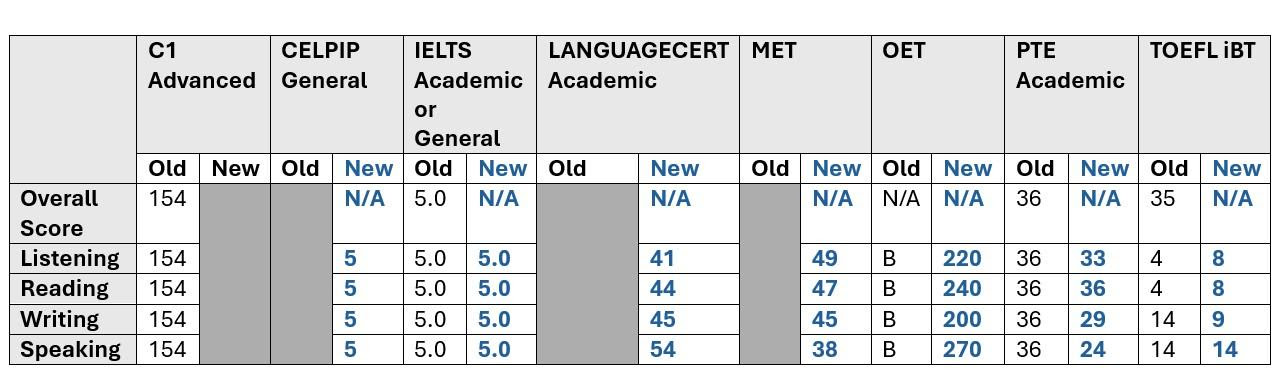
skills_in_demand_visaThe test is valid for 3 years from the first test sitting (original test day).

 

Transitional Arrangements

  • Applications lodged before 7 December 2024 are processed under the former TSS visa rules
  • Applications lodged on or after 7 December 2024 are assessed under the SID visa requirements 
  • Nominations lodged before 7 December 2024 without a linked visa application can still be linked to a SID visa application 
  • The salary threshold that applies is the one in force at the date the nomination was lodged — not the date of visa grant

Pathway to Permanent Residency

 1. Employer Nomination Scheme (subclass 186) — Temporary Residence Transition (TRT) Stream

Applicants must complete 2 years of full-time employment in the same occupation in Australia within the last 3 years, under a 457, TSS or SID visa. Employment with multiple sponsors is accepted as long as the total duration is continuous (excluding unpaid leave). See the Employer Nomination visa (186) page for full requirements.


2. Employer Nomination Scheme (subclass 186) — Direct Entry (DE) Stream

  • Limited to occupations on the Core Skills Occupation List (CSOL) 
  • Must have a positive skills assessment from the relevant assessing authority 
  • Must have at least 3 years of full-time relevant work experience

See the Employer Nomination visa (186) page for full eligibility details.

Key Features of the Skills in Demand Visa

  • Time with any approved employer counts toward the 2-year permanent residence requirement — not just time with the nominating sponsor
  • Self-nominated PR pathways available in addition to employer-sponsored pathways 
  • 4-year stay granted across all three streams 
  • Median processing time: 21 days (Core Skills); 7 days (Specialist Skills) 
  • 180 days to find a new sponsor if employment ends — significantly more time than under the old TSS framework
  • Workforce Australia advertising requirement removed — LMT is being streamlined 
  • Public sponsor register being published — making it easier to identify approved sponsors and move between employers

The SID visa is part of Australia’s broader Migration Strategy reforms, which include streamlined labour market testing, system-wide immigration process simplification, a new agency to identify skills needs (Jobs and Skills Australia) and a new points system for permanent skilled migration.

Talk to an Expert