
190 Visa Australia — Skilled Nominated Visa (Subclass 190)
What Is the Skilled Nominated Visa (Subclass 190)?
The 190 visa (Skilled Nominated visa) is a permanent skilled migration visa for eligible workers who are nominated by an Australian State or Territory government.
The 190 visa is points-tested and requires you to have an eligible skilled occupation, obtain a suitable skills assessment and submit an Expression of Interest (EOI) through SkillSelect. You must also meet the nomination requirements of the State or Territory you are seeking nomination from.
State or Territory nomination provides 5 additional points towards the skilled migration points test. However, meeting the minimum points requirement does not guarantee nomination or an invitation, as each State and Territory sets its own criteria and priorities.
If you receive State or Territory nomination and an invitation to apply, you can proceed with your subclass 190 visa application for Australian permanent residence.
190 Visa Eligibility Requirements
To be eligible for the Skilled Nominated visa (subclass 190), you generally need to:
- Be under 45 years of age when invited to apply
- Nominate an eligible skilled occupation (listed on MLTSSL and STSOL) and have a positive skills assessment
- Have at least Competent English and minimum 65 points on on your EOI, including the 5 points for State or Territory nomination
- Receive nomination from an Australian State or Territory government
- Meet the relevant health and character requirements
State Nomination Requirements
Meeting the Department of Home Affairs visa requirements does not automatically make you eligible for State or Territory nomination.
Each State and Territory sets its own nomination criteria, which may include requirements relating to your occupation, employment, work experience, English level, residency or connection to the State, and other priorities.
This means your eligibility for the 190 visa should be assessed together with the current nomination requirements of the State or Territory you intend to target.
Process of Skilled Nominated Visa (Subclass 190)
The subclass 190 visa process involves both State or Territory nomination and an invitation from the Department of Home Affairs.
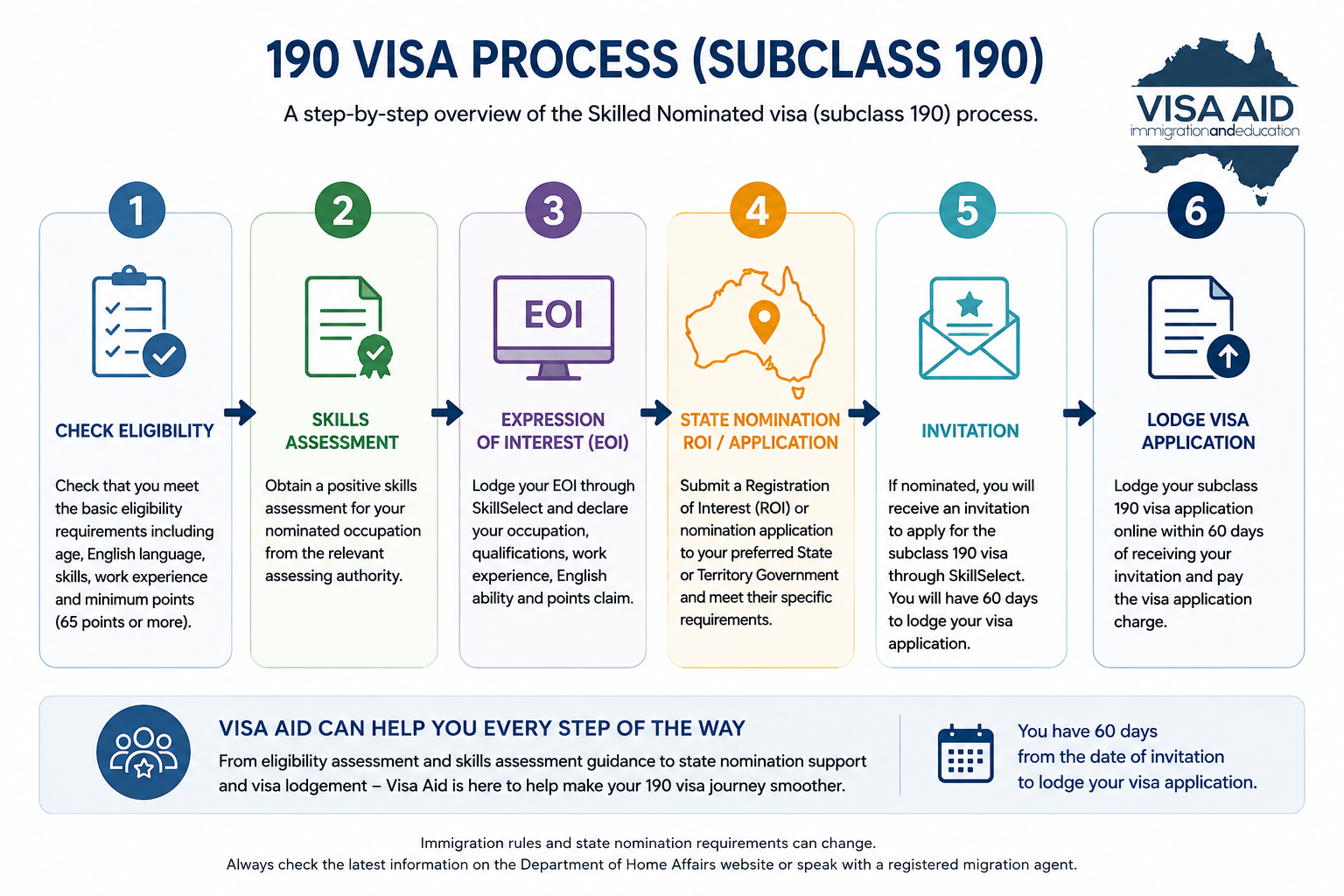
- Check your eligibility – Confirm your occupation, points score and eligibility for State or Territory nomination. VisaAid conducts a thorough initial assessment of your 190 visa eligibility — reviewing your qualifications, work experience, English language ability and overall circumstances to establish whether you meet the relevant requirements. VisaAid identifies the MLTSSL or STSOL occupation that best suits your profile, confirms your likely eligibility for a positive skills assessment, and assesses which State or Territory gives you the strongest chance of nomination. You then receive clear, comprehensive advice on meeting the minimum standards — including State/Territory nomination requirements — that the Department of Home Affairs requires for an invitation.
- Complete a skills assessment – Obtain a suitable skills assessment from the relevant assessing authority for your nominated occupation. When VisaAid’s initial assessment confirms your eligibility, VisaAid prepares and lodges your skills assessment application with the correct assessing authority for your nominated occupation. The Department designates one authority per occupation on the MLTSSL and STSOL — only an assessment from the correct authority satisfies the 190 visa requirements for an EOI. VisaAid provides a complete document checklist and lodges your application once you supply everything required.
- Submit an Expression of Interest (EOI) – Lodge your EOI through SkillSelect with details of your skills, qualifications, work experience, English ability and points claimed. Once you receive a positive skills assessment, VisaAid prepares and lodges your EOI in SkillSelect. At this stage you specify which State or Territory nomination you want to target — or you can make yourself available for nomination by any State or Territory if you have no preference. You do not need to attach supporting documents to your EOI, but you must be able to evidence every EOI claim at the time the Department invites you. VisaAid keeps your EOI current throughout the 2-year active period — updating it whenever your circumstances change, such as a new qualification, a higher English score or additional work experience — to maximise your nomination and invitation prospects.
- Seek State or Territory nomination – Your eligibility is assessed against the nomination criteria and priorities of the relevant State or Territory. Once VisaAid lodges your EOI, the government agency of your target State or Territory reviews it against their specific nomination criteria — including whether your nominated occupation appears on their priority list. VisaAid supplies the relevant State or Territory agency with the supporting evidence that proves you meet their criteria. The nature and extent of evidence required varies by state — some states require proof of a genuine connection to the state, minimum work experience or a higher English score than the Department’s baseline. You must commit to living and working in the nominating State or Territory for a minimum of 2 years.
- Receive an invitation to apply – If the state accepts your evidence and you meet all their criteria, the government agency nominates you for the subclass 190 visa and the Department then issues your formal invitation to apply. If you are nominated and invited, you can proceed with your subclass 190 visa application.
- Lodge your visa application – You must lodge a valid visa application within the timeframe specified in your invitation and provide evidence supporting the claims made in your EOI. Once the State or Territory nominates you and the Department issues your invitation, VisaAid prepares and lodges your complete 190 visa application within the 60-day invitation window. Your application includes every document that supports your EOI — skills assessment, English language test results, qualifications, work references, health examinations, police checks and all other required evidence. When the Department approves your application, it grants you a permanent visa. You can be in Australia or overseas when the Department makes its decision and grants the visa.
Because nomination criteria vary between States and Territories and can change, choosing where and when to seek nomination can be an important part of your 190 visa strategy.

Want to know which state will nominate you for the 190 visa?
If you need any help, please feel free to reach us.
Contact Now190 Visa Points Test – How Many Points Do You Need?
You need a minimum of 65 points to be eligible for the Skilled Nominated visa (subclass 190). The 5 points you receive for State or Territory nomination count towards this minimum points score.
However, 65 points is only the minimum eligibility threshold. It does not guarantee that a State or Territory will nominate you or that you will receive an invitation to apply. Your prospects can depend on your occupation, points score and the current nomination criteria and priorities of the State or Territory you are targeting.
You earn points across the following categories — use our Skilled Visa Points Test Table to calculate your full score:
- English language ability — up to 20 points
- Skilled employment — up to 20 points
- Age – up to 30 points
- Academic and vocational qualifications — up to 20 points
- Australian study requirement — 5 points
- Specialist education — 10 points
- Partner skills points — upto 10 points
- Community language (NAATI) — 5 points
- Professional year in Australia – 5 points
- State or Territory nomination — 5 points (automatically added for 190 applicants)
Are 65 Points Enough for a 190 Visa?
Not necessarily. Although 65 points is the minimum requirement, State and Territory nomination programs can be competitive and may apply their own selection criteria.
A higher points score may strengthen your profile, but points are not the only factor considered for State nomination. Your occupation, employment, work experience, English ability, location and other State-specific criteria may also affect your prospects.
Before submitting an EOI, it is important to understand both your 190 visa points score and the nomination requirements of the States or Territories you may be eligible for.
How to maximise your 190 visa points score:
- Achieve Proficient or Superior English — equivalent to IELTS 7.0 adds 10 points, IELTS 8.0 adds 20 points
- Complete a Professional Year in accounting, IT or engineering — adds 5 points
- Gain Australian work experience — up to 20 points
- Claim partner skills points — adds 10 points
- Explore NAATI community language points — adds 5 points
Not yet ready for the 190? The 491 regional visa adds 15 points through regional nomination and lets you build work experience toward the 191 permanent regional visa.
190 Visa State and Territory Nomination Requirements
To apply for the Skilled Nominated visa (subclass 190), you must receive nomination from an Australian State or Territory government.
Each State and Territory operates its own 190 visa nomination program and sets its own eligibility criteria, occupation priorities and selection requirements. These requirements are separate from the Department of Home Affairs visa requirements and can change during the migration program year.
Depending on the jurisdiction, factors such as your nominated occupation, points score, English ability, skilled employment, work experience, current location and connection to the State or Territory may affect your eligibility for nomination. Importantly, meeting the minimum requirements for the subclass 190 visa does not guarantee State or Territory nomination.
Check Current 190 State Nomination Requirements
State nomination programs can change as governments respond to workforce priorities and available nomination allocations.
See our detailed 190 visa state nomination requirements guide for current requirements, occupation priorities and nomination information for different states.
Unsure which State to target? VisaAid can assess your occupation, points and circumstances against current nomination pathways to help identify suitable options.To confirm which state gives your occupation and profile the best chance of nomination, speak to a VisaAid migration consultant before you target a specific state.
After You Receive Your 190 Visa Invitation
Once you receive an invitation to apply for the Skilled Nominated visa (subclass 190), you have 60 calendar days to lodge your visa application.
Before applying, you should carefully review your invitation, EOI and supporting evidence. Your visa application must substantiate the claims on which your invitation was based.
In particular, make sure that:
- You can provide evidence for the points claimed in your EOI
- Your skills assessment and other time-sensitive documents satisfy the applicable requirements
- Your identity, qualification and employment documents are complete
- Your English language evidence meets the relevant requirements
- Information in your application is accurate and consistent with your EOI
- Documents not in English are accompanied by appropriate translations
An invitation gives you the opportunity to apply; it does not guarantee that the subclass 190 visa will be granted.
Including Family Members
Eligible members of your family unit may be included in your subclass 190 visa application. This may include your partner and eligible dependent children, depending on your circumstances. Family members included in the application must satisfy the applicable visa requirements, including health and character requirements.
Additional Visa Application Charges may apply for family members included in the application. Every family member the Department grants the visa to receives the same permanent residence rights — full work and study rights, Medicare access, travel facility and a pathway to Australian citizenship.
Can You Apply for a 190 Visa Onshore or Offshore?
You can apply for the subclass 190 visa from inside or outside Australia.
If you are applying while in Australia, your current visa status is important. You must be eligible to lodge the application in Australia and should check whether any conditions or previous visa history could affect your ability to make a valid application. Your location and visa status should therefore be checked before lodging, particularly if your current Australian visa is approaching expiry. If you lodge a valid subclass 190 visa application while you are in Australia, you may be granted a Bridging Visa.
Visa Cost – Subclass 190 — Department of Home Affairs Fees
The 190 visa application fee is from AUD 6,140 for the main applicant. Additional visa application charges apply for family members included in your application. An additional second instalment visa application charge may also apply to certain family members aged 18 or over who do not have functional English. Visa application charges can change, so the applicable Department of Home Affairs fee should be confirmed at the time you lodge your application.
Your total subclass 190 visa process cost may also include expenses such as:
- Skills assessment fees
- English language test fees
- Health examinations
- Police certificates and biometrics, where required
- State or Territory nomination application fees, where applicable
How VisaAid Helps With Your 190 Visa
VisaAid’s registered migration consultants manage every stage of your subclass 190 visa application:
- Identifying your best State or Territory nomination strategy
- Obtaining your skills assessment from the correct assessing authority
- Preparing and lodging your EOI in SkillSelect
- Securing your State or Territory nomination
- Lodging and monitoring your visa application until grant
- All correspondence with assessing authorities and the Department of Home Affairs
- Managing bridging visas for you and your family members
Book a free 190 visa consultation for a personalised eligibility and nomination strategy assessment.
After Your 190 Visa Is Granted
Once your Skilled Nominated visa (subclass 190) is granted, you become an Australian permanent resident. As a permanent resident, you can live, work and study in Australia indefinitely. You may also be eligible to enrol in Medicare, sponsor eligible relatives for certain visas and, once you meet the relevant requirements, apply for Australian citizenship. Your visa grant notification will confirm the date your visa takes effect and other important information relating to your permanent residence.
What Are the Travel Rights on a 190 Visa?
The subclass 190 visa provides a 5-year travel facility from the date of visa grant.
During this period, you can leave and re-enter Australia as a permanent resident while the travel facility remains valid. Your permanent residence does not simply expire after five years. However, if you want to return to Australia as a permanent resident after your travel facility has expired, you will generally need an appropriate Resident Return Visa (subclass 155 or 157) , unless you have become an Australian citizen.
It is important to distinguish between your permanent resident status and the travel facility attached to your visa, particularly if you intend to spend significant periods outside Australia.
Speak to a VisaAid migration consultant if you need to travel overseas after 5 years of your 190 Visa grant.
From the 190 Visa to Australian Citizenship
The 190 visa delivers permanent residence immediately — and from that point, your path to Australian citizenship begins. Most applicants meet the citizenship residency requirement after 4 years of lawful residence (including at least 1 year as a permanent resident).
NOTE: The information provided is general in nature and should not be considered migration advice. As every individual’s circumstances are different, we recommend contacting VisaAid for personalised advice.